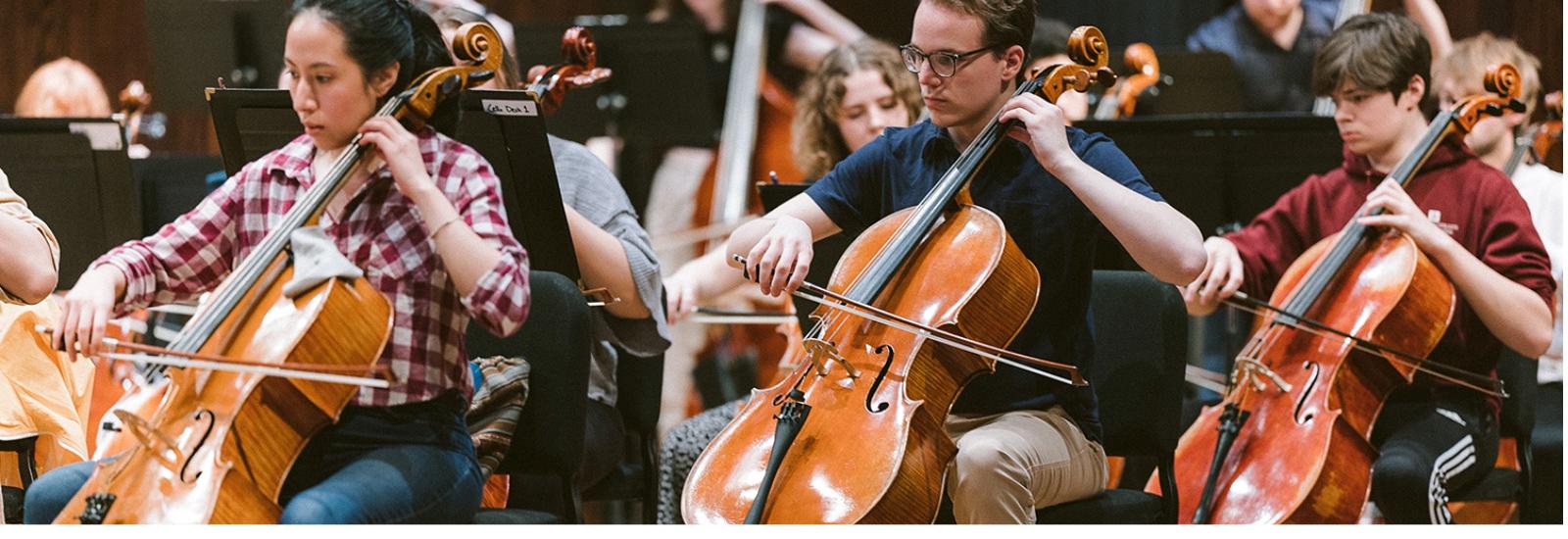
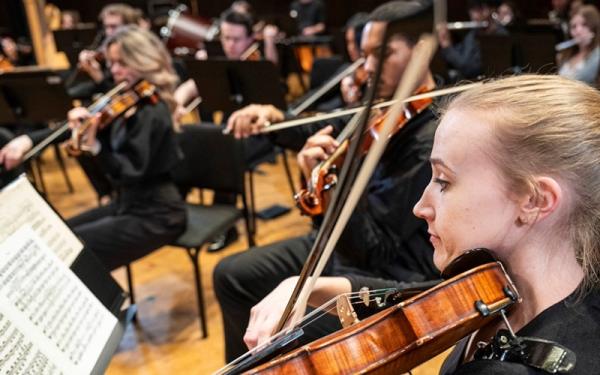
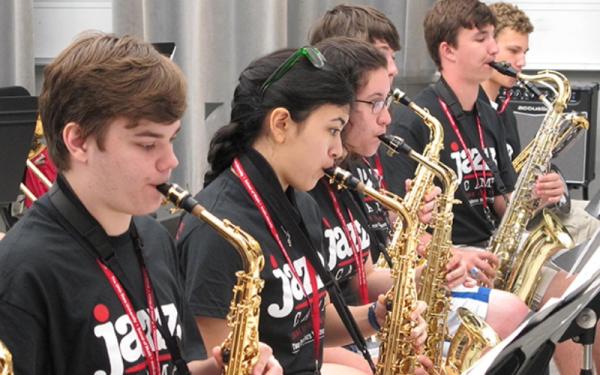
The CSML has conducted a broad range of research in the fields of systematic and empirical musicology, as well as the psychology and cognition of music. Lab members are encouraged to work on whatever projects seem most promising and appealing to them; nonetheless, the laboratory has recently been focusing on musical expectation, affect and emotion, and particularly musical sadness.
At the School of Music, undergraduate students enrolled in aural skills courses are required to take part in the Music Research Program. The purpose of this program is to expose students to the methods of research, while facilitating experiments that require the participation of musicians.
Selected Publications
2011
Huron, D. (2011). Why is sad music pleasurable? A possible role for prolactin. Musicae Scientiae, 15 (2), 146-158.
Plazak, J., Huron, D. (2011). The first three seconds: listener knowledge gained from brief musical excerpts. Musicae Scientiae, 15 (1), 29-44.
2010
Paul, B., & Huron, D. (2010). An association between breaking voice and grief-related lyrics in Country Music. Empirical Musicology Review, 5 (2), 27-35. [pdf]
Plazak, J., Huron, D., & Williams, B. (2010). Fixed Average Spectra of Orchestral Instrument Tones. Empirical Musicology Review, 5 (1), 10-17. [pdf]
2009
Huron, D., Dahl, S., & Johnson, R. (2009). Facial Expression and Vocal Pitch Height: Evidence of an Intermodal Association. Empirical Musicology Review, 4 (3), 93-100. [pdf]
Post, O., & Huron, D. (2009). Western classical music in the minor mode is slower (except in the Romantic period). Empirical Musicology Review, 4 (1), 2-10. [pdf]
2008
Plazak, J. (2008). The Effects of Attention on Frisson-Related Responses from Unexpected Musical Events. The Ohio State School of Music Online Journal. Volume 1, Issue 2. [html]
Collister, L. B., & Huron, D. (2008). Comparison of Word Intelligibility in Spoken and Sung Phrases. Empirical Musicology Review, 3 (3). 109-125. [pdf]
Paul, B. (2008). "Bilateral Keyboard Symmetry in the Music of Einojuhani Rautavaara. The Ohio State School of Music Online Journal, 1 (2). [html]
Turner, B., & Huron, D. (2008). A Comparison of Dynamics in Major- and Minor Key Works. Empirical Musicology Review, 3 (2), 64-68. [pdf]
Huron, D. (2008). A Comparison of Average Pitch Height and Interval Size in Major- and Minor-key Themes: Evidence Consistent with Affect-related Pitch Prosody. Empirical Musicology Review, 3 (2), 59-63. [pdf]
Huron, D. (2008). Lost in music. Nature, 453, 456-458. [pdf]
2006
Huron, D., & Ommen, A. (2006). An empirical study of syncopation in American popular music, 1890-1939. Music Theory Spectrum, 28 (2), 211-321. [pdf]
Huron, D., Kinney, D., & Precoda, K. (2006). Influence of Pitch Height on the Perception of Submissiveness and Threat in Musical Passages. Empirical Musicology Review, 1 (3), 170-177. [pdf]
2003
Huron, D., & Ollen, J. (2003). Agogic contrast in French and English themes: Further support for Patel and Daniele (2003). Music Perception, 21 (2), 267-271. [pdf]
2001
Huron, D. (2001). Tone and Voice: A Derivation of the Rules of Voice-Leading from Perceptual Principles. Music Perception, 19 (1), 1-64. [pdf]
Huron, D. (2001). Is Music an Evolutionary Adaptation?. Annals of the New York Academy of Sciences, 930, 43-61. [pdf]
2000
von Hippel, P., & Huron, D. (2000). Why do skips precede reversals? The effect of tessitura on melodic structure. Music Perception, 18 (1), 59-85. [pdf]
1999
Huron, D. & Collins, D. (1999). Voice-leading in cantus firmus-based canonic composition: A camparison between theory and practice in Renaissance and Baroque music using compurter-assisted inferential measures. Computers in Music Research, Vol. 6, pp. 53-95.
1996
Huron, D. (1996). The melodic arch in Western folksongs. Computing in Musicology, Vol. 10, pp. 3-23.
Huron, D. & Royal, M. (1996). What is melodic accent? Converging evidence from musical practice. Music Perception, Vol. 13, No. 4, pp. 489-516. [pdf]
1994
Simpson, J. & Huron, D. (1994). Absolute pitch as a learned phenomenon: Evidence consistent with the Hick-Hyman Law. Music Perception, Vol. 12, No. 2, pp. 267-270. [pdf]
Huron, D. (1994). Interval-class content in equally-tempered pitch-class sets: Common scales exhibit optimum tonal consonance. Music Perception, Vol. 11, No. 3, pp. 289-305. [pdf]
1993
Huron, D. & Parncutt, R. (1993). An improved model of tonality perception incorporating pitch salience and echoic memory. Psychomusicology, Vol. 12, No. 2, pp. 154-171.
Huron, D. (1993) Chordal-tone doubling and the enhancement of key perception. Psychomusicology, Vol. 12, No. 1, pp. 73-83.
Huron, D. (1993). Note onset asynchrony in J.S. Bach's Two-part Inventions. Music Perception, Vol. 10, No. 4, pp. 435-444. [pdf]
1992
Orpen, K. & Huron, D. (1992). The measurement of similarity in music: A quantitative approach for non-parametric representations. Computers in Music Research, Vol. 4, pp. 1-44.
Huron, D. & Sellmer, P. (1992). Critical bands and the spelling of veritcal sonorities. Music Perception, Vol. 10, No. 2, pp. 129-149. [pdf]
Huron, D. (1992). The ramp archetype and the maintenance of auditory attention. Music Perception, Vol. 10, No. 1, pp. 83-92. [pdf]
1991
Huron, D. (1991). Tonal consonance versus tonal fusion in polyphonic sonorities. Music Perception, Vol. 9, No. 2, pp. 135-154. [pdf]
Huron, D. (1991). The avoidance of part-crossing in polyphonic music: Perceptual evidence and musical practice. Music Perception, Vol. 9, No. 1, pp. 93-104. [pdf]
Huron, D. (1991). The ramp archetype: A study of musical dynamics in 14 piano composers. Psychology of Music, Val. 19, No. 1, pp. 33-45. [pdf]
1990
Huron. D. (1990). Crescendo/Diminuendo asymmetries in Beethoven's piano sonatas. Music Perception. Vol. 7, No. 4, pp. 395-402. [pdf]
Huron. D. (1990).Increment/Decrement asymmetries in polyphonic sonorities. Music Perception. Vol. 7, No. 4, pp. 385-393. [pdf]
1989
Huron, D. (1989). Music in advertising: An analytic paradigm. Musical Quarterly, Vol. 73, No. 4, pp. 557-574. [pdf]
Huron, D. & Fantini, D. (1989). The avoidance of inner-voice intries: Perceptual evidence and musical practice. Music Perception, Vol. 7, No. 1, pp. 43-47. [pdf]
Huron, D. (1989). Voice denumerability in polyphonic music of homogeneous timbres. Music Perception, Vol. 6, No. 4, pp. 361-382. [pdf]
1988
Huron, D. (1988). Error categories, detection and reduction in a musical database. Computeres and the Humanities, Val. 22, No. 4, pp. 361-382. [pdf]
1986
MacKenzie, B., VanEerd, D., Graham, E., Huron, D., & Wills, B. (1986). The effect of tonal structure on rhythm in piano performance. Music Perception, Vol. 4, No. 2, pp. 215-225. [pdf]
Conference Proceedings
Plazak, J., Huron, D. (2010). The First Three Seconds: Listener Knowledge Gained from Brief Musical Excerpts. Demorest, S. ed. Proceedings of the 11th International Conference for Music Perception and Cognition.
Paul, B. (2010). Nostalgia-Inducing Music and Perceptions of Social Support Satisfaction. Demorest, S. ed. Proceedings of the 11th International Conference for Music Perception and Cognition.
Davis, M., Essig, D. (2010). An Examination of Auditory Preferences and Aversions in Mice. Demorest, S. ed. Proceedings of the 11th International Conference for Music Perception and Cognition.
Huron, D. Davis, M., (2010). The Effect of Scale Degree Modifications on Average Interval Size. Demorest, S. ed. Proceedings of the 11th International Conference for Music Perception and Cognition.
Ollen, J. & Huron, D. (2004). Listener preferences and early repetitions in musical form" In: S. Lipscomb, R. Ashley, R. O. Gjerdingen, & P. Webster (editors), Proceeings of the 8th International Conference on Music Perception and Cognition. Evanston, Illinois, 2004 pp. 405-407.
Conference Presentations
Post, O., Yim, G., Jakubowski, K., Paul, B., & Tiemann, L. (October 30, 2009). Parallels between sad music and sad speech. Society for Music Theory Conference. Montreal, QC, Canada.